Mixon
Hall
June
20
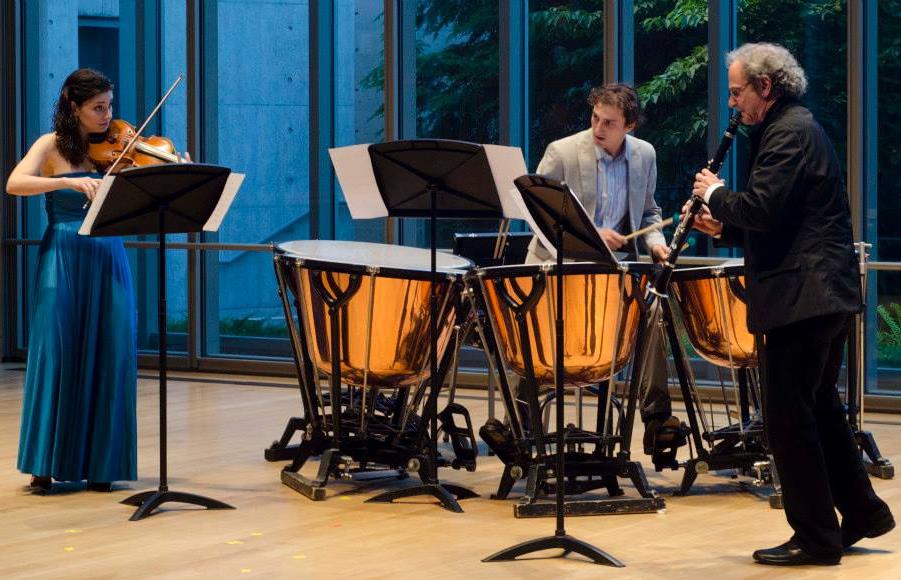 |
| The family that plays together: Diana, Alex and Franklin. |
Chamber
music concerts tend to be cerebral affairs, with smaller ensembles
and venues giving listeners an opportunity to focus on the
intricacies of complex music. ChamberFest Cleveland has that part
right. But as the opening concert demonstrated, this festival comes
from the heart.
The
opening piece set the tone: Start-time,
a new work by Matan Porat written expressly for the festival’s
founders and directors, Franklin Cohen and his daughter Diana. Joined
by brother Alexander on timpani, they premiered what is likely the
first modern piece composed for clarinet, violin and timpani – an
odd combination, to say the least. But the Cohens made it work with a
finely calibrated interplay of the three instruments that gradually
rose in volume and intensity to the fevered pitch of a tribal dance.
Cohen
Sr. could not have been prouder in noting that it was the first
time he and his children had performed together. And the piece could
not have been more appropriate, a fresh blast of harmonics and
propulsive rhythms played in a celebratory spirit.
An
ad hoc ensemble of string players followed with a more conventional
repertoire work, Mozart’s Quintet for Two Violins, Two Violas
and Cello in G minor (K. 516). In any other context, the piece
would hardly seem conventional. It’s a late work filled with
uncharacteristic dark tones and emotional anguish, with the G minor
key setting a somber, melancholy mood. And the combination of
instruments was still considered experimental at the time Mozart
composed the piece in the spring of 1787, when his personal fortunes
were at a low ebb and falling.
All
of which helps to explain why the Quintet sounded so flat. The
group – violinists David McCarroll and Diana Cohen, violists Yura
Lee and Dimitri Murrath, and cellist Julie Albers – gave it a
professional reading and played with intelligence and sensitivity.
But there was little of the internal logic that characterizes
high-caliber Mozart, and only hints of emotional depth. It may be
unrealistic to expect more from a group of musicians who don’t
normally play together, no matter how skilled they are individually.
Still, the energy and passion that finally emerged late in the final
movement suggested that the ensemble was capable of more.
By
contrast, the final piece was superb. Messiaen’s Quartet for the
End of Time is a work of breathtaking beauty and demanding
virtuosity, which made it ideal for the senior Cohen, who has been
the Cleveland Orchestra’s principal clarinetist for nearly 40
years. The level of playing and interpretation went up several
notches with him leading a group that included violist Lee, cellist
Gabriel Cabezas and pianist Orion Weiss. The opening “Liturgy”
movement was sharp and smart, and Weiss displayed impressive range in
the “Vocalise,” segueing smoothly from controlled banging to soft
cascades.
Cohen
showed perfect control of his instrument in the “Abyss of the
Birds,” adding some flourishes to the sound with swipes of his
clarinet. Cabezas struck a compelling tone and drew some clever
effects from his instrument for the following “Praise” movement,
setting up an outstanding “Dance of Fury” – vibrant and clean,
played with an integrity and rhythm that gave it a jazzy feel. The
concluding “Angel” and “Immortality of Jesus” movements were
less impressive, but only by comparison. The entire piece was so
riveting that there was an audible exhale when it ended, one of those
rare moments when the entire audience has been transfixed.
The
only sour note of the night came in a short program that preceded the
concert. “This is an unusual way to start,” Diana Cohen
acknowledged in introducing Cabezas and Weiss for a two-piece recital
designed to showcase the cellist. He is a young player of
considerable talent who did not seem very comfortable with delicate
works by Janáček and Debussy.
And the placement of the recital was puzzling. Supporting young
artists is an admirable goal, but not to open a festival. Caberzas
needs some seasoning and the schedule needs refining.
Meanwhile,
Mixon Hall continues to surprise and delight. At a certain point as
twilight set in, there was a mirror image of the performers in the
double glass wall behind the stage, as if an ethereal second group
was performing in the garden. The effect was dreamlike, adding a
magical moment to an already enchanting evening.
For
more on Franklin Cohen:
http://chamberfestcleveland.com/portfolio/franklin-cohen/
For
more on Matan Porat:
http://chamberfestcleveland.com/portfolio/matan-porat/
Photo by Gary Adams

